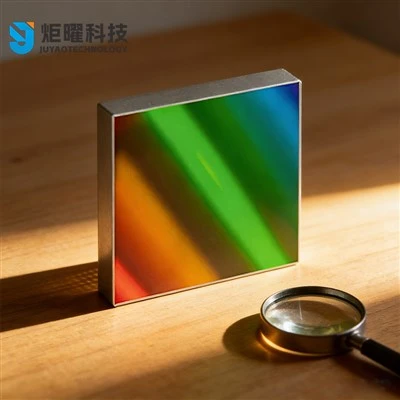
Spectroscopische analyse: Instrumenten zoals atoomabsorptiespectrometers en Raman-spectrometers zijn afhankelijk van reflectieroosters om golflengtescheiding met hoge-resolutie te bereiken en de samenstelling van stoffen te detecteren.
Lasertechnologie: In vaste{0}} lasers en fiberlasers fungeren roosters als spiegels met resonante holtes, waardoor een single- output wordt bereikt via golflengteselectie.
Optische communicatie: Wavelength Division Multiplexing (WDM)-systemen maken gebruik van roosterarrays om lichtsignalen met verschillende golflengten naar onafhankelijke kanalen te distribueren, waardoor de transmissiecapaciteit toeneemt.
Biogeneeskunde: Flowcytometrie maakt gebruik van roosters om fluorescent gelabelde cellen te detecteren, waardoor multi-parameteranalyse op celniveau- mogelijk wordt.
Momenteel ontwikkelt de technologie voor reflectieroosters zich in twee richtingen: miniaturisatie, het gebruik van nano-imprinting of elektronenbundellithografie om microroosters met lijnbreedtes te vervaardigen.<100nm for use in chip-level spectrometers; and multifunctionality, combining gratings with materials such as metasurfaces and liquid crystals to achieve dynamic wavelength tuning or polarization control. However, the fabrication of high-precision gratings still faces technological challenges such as grating uniformity and surface roughness (requiring <0.5nm), and the cost increases exponentially with grating density.